
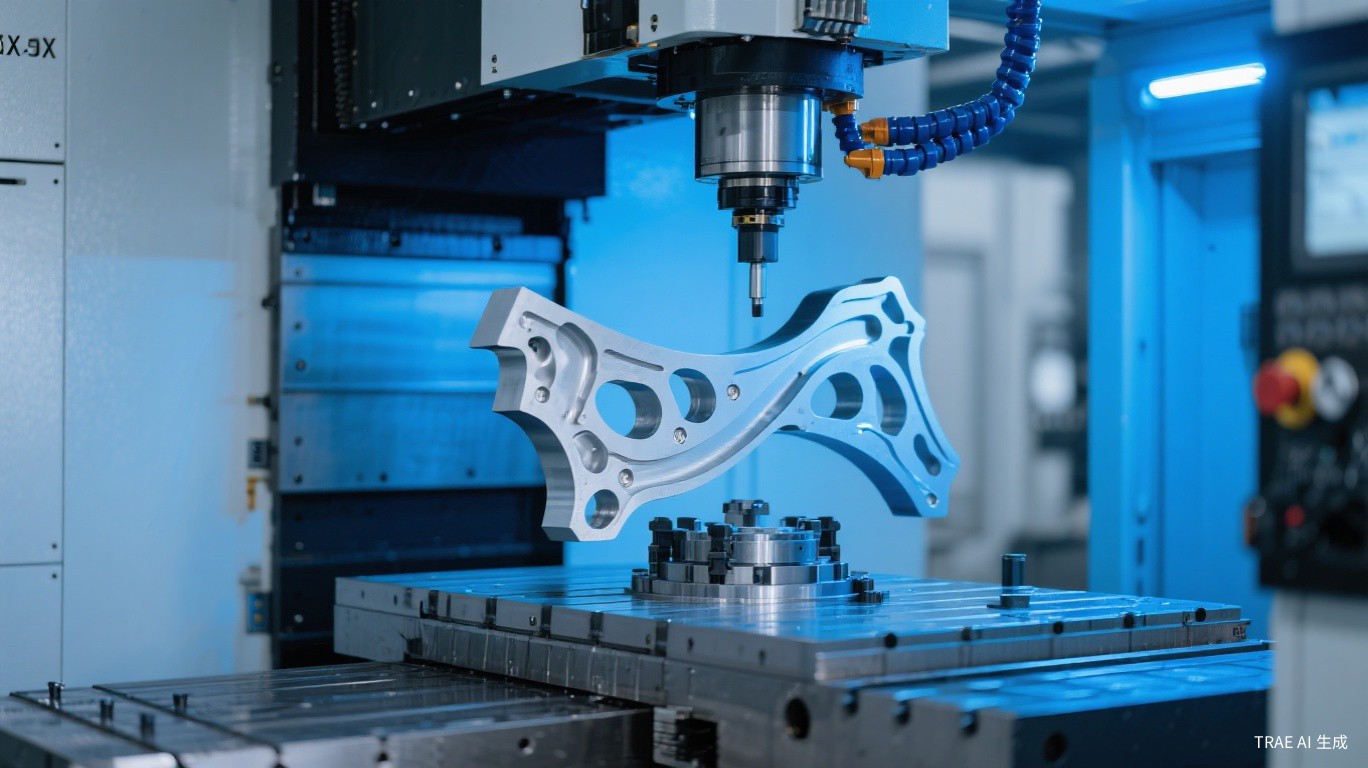
5-axis CNC machining represents one of the most advanced capabilities in modern precision manufacturing. Unlike traditional 3-axis machines that move along the X, Y, and Z linear axes, 5-axis machines add two rotational axes that allow the cutting tool to approach the workpiece from virtually any angle. This capability fundamentally transforms how complex parts are manufactured.
Understanding 5-Axis Machining
The two additional rotational axes in 5-axis machining are typically designated as the A-axis (rotation around the X-axis) and C-axis (rotation around the Z-axis). This configuration allows the workpiece to be positioned at any orientation relative to the cutting tool, eliminating the need for multiple setups and repositioning that would otherwise be required for complex geometries.
There are two primary configurations for 5-axis machines: trunnion-style machines where the table rotates, and gantry-style machines where the spindle head rotates. Each configuration offers distinct advantages depending on the specific application requirements, part sizes, and production volumes.
Reduced Setup Time: The Efficiency Advantage
Perhaps the most significant benefit of 5-axis machining is the dramatic reduction in setup time. Traditional 3-axis machining of complex parts often requires multiple setups where the workpiece must be removed, repositioned, and re-registered for each different machining orientation. Each setup introduces potential errors, consumes valuable production time, and requires skilled operator intervention.
With 5-axis capability, complex parts can often be completed in a single setup. The machine can access all surfaces and features without manual repositioning. This single-setup approach reduces total production time by 50-70% for many complex parts, translating directly into cost savings and faster delivery times.
Setup Time Comparison:
- Traditional 3-axis: 3-5 setups for complex aerospace components
- 5-axis machining: Often completed in 1 setup
- Setup time reduction: Up to 70% savings
- Operator intervention: Minimal compared to multi-setup processes
Enhanced Precision and Surface Quality
5-axis machining enables superior precision because the cutting tool can maintain optimal orientation relative to the workpiece surface throughout the machining process. This capability allows the use of shorter, more rigid cutting tools that deflect less under cutting forces, resulting in tighter tolerances and better surface finishes.
When machining complex curved surfaces, 5-axis machines can keep the tool normal to the surface, maintaining consistent cutting conditions. This eliminates the stair-step effect common in 3-axis machining of curved surfaces and produces smoother, more accurate geometries that often require no secondary finishing operations.
"5-axis machining transforms what would be a multi-day, multi-setup process into a single, continuous operation. The precision gains and time savings are transformative for complex part production."
Applications in Aerospace and Medical Industries
The aerospace and medical device industries represent ideal applications for 5-axis machining due to their requirements for complex geometries, tight tolerances, and demanding materials. Aerospace components such as turbine blades, structural brackets, and impellers feature intricate curves and undercuts that would be impossible or extremely inefficient to produce with conventional 3-axis equipment.
Medical devices including surgical instruments, orthopedic implants, and dental components require complex organic shapes that precisely match anatomical requirements. Titanium and other challenging materials common in medical applications are machined more efficiently with 5-axis capability, as optimal tool orientation reduces cutting forces and extends tool life.
Key Industry Applications:
- Aerospace: Turbine blades, structural components, impellers, engine parts
- Medical: Orthopedic implants, surgical tools, dental prosthetics
- Automotive: Complex prototypes, custom components, tooling
- Energy: Valve bodies, pump components, turbine parts
Cost Considerations and ROI
While 5-axis machines represent a significant capital investment, the return on investment for appropriate applications is compelling. Reduced setup time, fewer fixtures, shorter lead times, and improved quality all contribute to substantial cost savings over traditional multi-setup approaches. For production volumes above certain thresholds, 5-axis machining becomes economically advantageous even for parts that could technically be produced with 3-axis equipment.
Additionally, 5-axis capability opens opportunities to manufacture parts that would otherwise be impossible, creating competitive advantages and enabling participation in high-value market segments. The ability to quote competitive pricing on complex parts while delivering superior quality positions manufacturers for success in demanding industries.
When to Choose 5-Axis Machining
5-axis machining is most beneficial for parts featuring complex geometries, multiple angled surfaces, deep cavities, or undercuts. Parts requiring tight tolerances on multiple surfaces, components made from difficult materials, and production situations where setup time significantly impacts costs are ideal candidates. Consulting with experienced machining professionals helps determine whether 5-axis capability offers advantages for your specific requirements.